

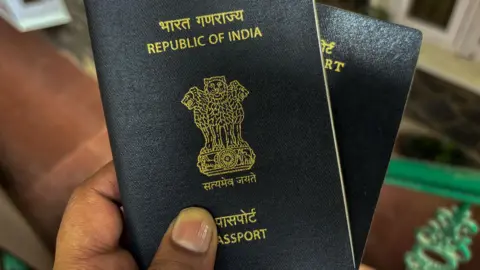
In recent months, an online clip by an Indian travel influencer expressing frustration over India's weak passport gained massive traction on social media.
The influencer stated although nearby nations like Sri Lanka and Bhutan offered easier access to travelers from India, securing travel permits for visiting most Western and European countries continued to be difficult.
This dissatisfaction with India's poor passport strength was reflected in the latest Henley Passport Index, which placed India in the 85th spot among 199 countries, five spots lower compared to the previous year.
The Indian government has not commented on the report yet.
Nations like Ghana, Rwanda and Azerbaijan despite smaller economic size compared to India – which is the fifth-largest economy globally – hold better positions on the index at the 78th, 74th and 72nd spots, respectively.
Actually, India's rank in the past decade has remained around the eighties, falling to ninetieth place two years ago. These rankings appear poor when measured against Asian nations such as Singapore, Japan and South Korea, all maintaining top positions.
Global Passport Power Indicates
The power of a passport indicates a country's global influence and international standing. It also translates into enhanced travel freedom for its citizens, improving commercial and learning opportunities. A weak passport means additional documentation, increased visa expenses, reduced travel benefits and extended processing periods for travel.
But despite the drop in position, the number of countries offering visa-free access to Indians has actually increased in the past decade or so.
As an instance, in 2014 – the year the current administration's ruling party came to power – 52 countries offered visa-free travel for Indian passport holders with the passport ranked 76th in the ranking.
A year later, it tumbled to eighty-fifth place, then rose to 80th over the past two years, declining once more to the eighty-fifth spot this year. At the same time, visa-free destinations to Indian citizens grew from 52 in 2015 to sixty last year and sixty-two this year.
Increasing Worldwide Travel Competition
The count of nations allowing visa-free entry in 2025 (57) is higher than the number in 2015 (52), but India's rank during both periods is 85. What explains this situation?
Analysts note that a major reason is the increasingly competitive landscape in global mobility – indicating that nations are forming more travel partnerships to benefit their citizens and economic growth. According to recent analysis, the global average count of countries travellers are able to access without visas has almost doubled from 58 in 2006 to one hundred nine currently.
As an illustration, China has increased its count of visa-free destinations available to its citizens from fifty to eighty-two in the past decade. As a result, its position on the index has enhanced from 94th to 60th in that same duration.
In comparison, India – previously positioned 77th on the index in July – dropped to the 85th position in October after losing access to two countries.
Other Influences Impacting Passport Power
A former Indian ambassador notes multiple elements influencing a nation's passport power, like economic and political conditions plus its openness to welcoming citizens from other countries.
For instance, the US passport has dropped out of the top 10 and now occupies the 12th position – a historic low – because of its more inward-looking approach in global affairs.
The diplomat recalls that during the seventies, Indian citizens had visa-free access to numerous European and Western nations, though this shifted following Sikh separatist movement in the 1980s. Later political disturbances have continued to damage the country's reputation as a stable, democratic country.
"Many countries are also becoming increasingly wary regarding migrants," the diplomat added. "India has a large quantity of people migrating overseas or remaining beyond visa limits affecting the country's reputation."
Elements like the security level of a national passport and its immigration procedures also play a role to obtaining visa-free access to foreign nations.
Security and Technological Improvements
The Indian passport faces ongoing security risks. In 2024, law enforcement arrested over two hundred individuals for suspected visa and passport fraud. India is also known for cumbersome immigration procedures and a slow pace for visa approvals.
The diplomat says that technological advances, such as the newly introduced electronic passport or e-passport, can improve security and streamline immigration. This electronic document includes a small chip that stores biometric data, increasing difficulty to forge or tamper with the document.
However, increased diplomatic efforts and travel partnerships remain key for enhancing the global mobility for Indian citizens and, by extension, India's passport ranking.


